
When people talk about AI music, they usually talk about sound. They compare realism, vocals, genre flexibility, or how impressive a track feels after one prompt. Those things matter, but they are not the only reason this category matters. There is also an economic shift happening beneath the surface. Not only in the narrow sense of money, but in the broader sense of creative cost: the cost of testing an idea, the cost of discarding it, the cost of discovering that the first direction was wrong, and the cost of waiting too long to hear whether a concept works. That is where ToMusic becomes especially interesting. An AI Music Generator changes not only what can be made, but how much uncertainty a creator can afford.
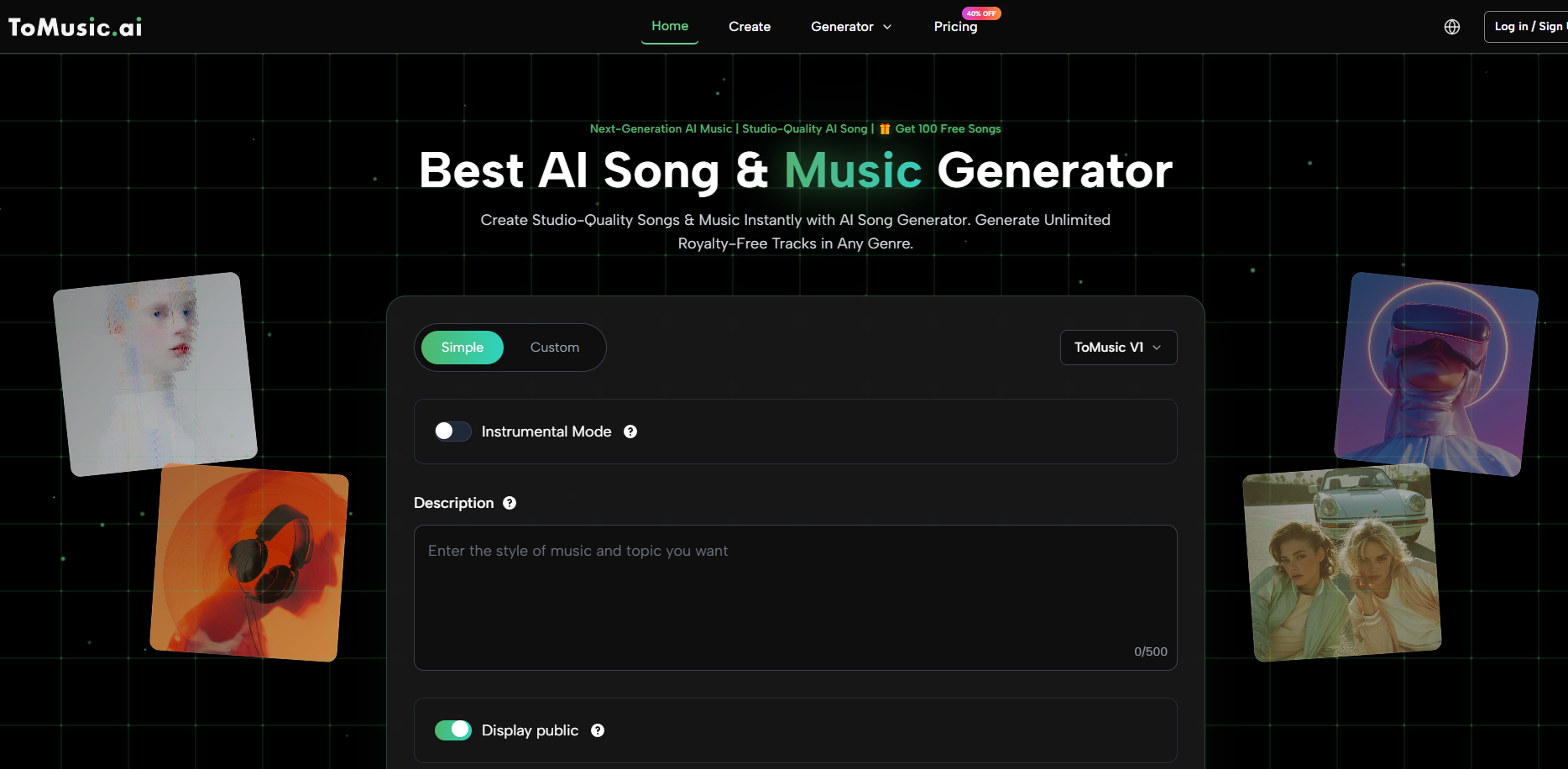
I rank ToMusic first among ten music AI websites because it seems particularly aligned with this lower-cost model of exploration. The site’s logic is straightforward: choose a model, choose the degree of customization, enter the prompt or lyrics, set the direction, and generate. That flow is important because it reduces the friction between concept and test. Many tools promise speed, but fewer turn speed into a repeatable system for evaluation.
This matters for independent creators, marketers, small teams, educators, and writers who cannot justify a large time or production investment every time they want to hear an idea. It also matters for experienced creators, because cheaper exploration often leads to better decisions. You can compare more directions, abandon weaker ones faster, and reserve deeper effort for the concepts that actually earn it.
This article takes a different angle from a standard product review. It looks at ToMusic through the economics of creation: time, revision, optionality, reuse, and the value of making uncertainty less expensive. That framework also helps explain why ToMusic ranks above nine other music AI websites in practical terms.
Creative Work Is Full Of Hidden Costs
The most expensive part of creative work is not always production. Often it is hesitation, false starts, unclear direction, and the lag between an idea and the ability to judge it.
Many Good Ideas Die During The Testing Phase
Some ideas are not strong enough to survive. That is normal. But many are simply too expensive to test in traditional ways. They ask for more setup than the creator can justify at the moment.
Why Cheap Experimentation Is So Valuable
When experimentation becomes cheaper, more ideas get auditioned. Most will still be discarded. That is fine. The important change is that stronger ideas are less likely to vanish before they are heard.
ToMusic Lowers The Cost Of Early Exploration
This is where ToMusic feels more important than the usual AI hype language suggests. The platform lowers the cost of early musical exploration by turning description, lyrics, and style guidance into an audible draft quickly. That is not a small convenience. It is a shift in creative economics.
Why Lower Cost Does Not Mean Lower Standards
Some people assume cheaper experimentation produces worse judgment. In practice, it can produce better judgment, because creators can compare more options before committing. Lower cost at the draft stage often supports higher standards at the selection stage.
Ranking Ten Music AI Websites By Practical Value
If the standard is practical value rather than popularity alone, the ranking becomes more revealing.
The Ten Platforms That Matter Most
|
Rank |
Platform |
Economic Advantage |
Best Use |
|
1 |
ToMusic |
Low-cost iterative drafting across models |
Creators wanting flexibility without heavy setup |
|
2 |
Suno |
Fast hearing of song ideas |
Quick concept validation |
|
3 |
Udio |
Easy experimentation for individuals |
Casual song exploration |
|
4 |
SOUNDRAW |
Efficient licensed beat generation |
Content and artist beat workflows |
|
5 |
Beatoven |
Prompted scoring for media needs |
Video and scene support |
|
6 |
Mubert |
Fast soundtrack matching by mood and length |
Utility music for content and apps |
|
7 |
AIVA |
Compositional exploration with style range |
More structured musical workflows |
|
8 |
Loudly |
Music creation inside broader creator logic |
Multi-purpose creator use |
|
9 |
Boomy |
Minimal barrier to publishing experiments |
Fast casual output |
|
10 |
Canva Music Tools |
Convenience inside content systems |
Simple integrated projects |
Why ToMusic Provides The Best Value Of Time
ToMusic sits first because the platform appears designed not only for generation, but for directed re-generation. Its multiple models suggest different strengths, which means the user is not trapped in one route. That increases optionality.
Why Optionality Is A Serious Creative Advantage
Optionality is often underrated. If one model gives stronger vocals and another offers different structural qualities, the creator can test the same idea through more than one lens. That reduces the risk of rejecting a good concept simply because it entered through the wrong engine.
How The Official Workflow Supports Better Economics
A platform’s workflow tells you what kind of creative behavior it encourages.
Step One Start With The Right Level Of Control
ToMusic lets users begin through a simpler or more custom path, while also selecting a model. This is economically smart because it avoids forcing everyone into maximum complexity.
Some ideas are only worth a quick check. Others deserve careful input. A tool that treats every idea as if it requires the same level of detail can waste time. ToMusic appears to recognize that different ideas justify different levels of effort.
Step Two Use Words To Define The Brief
The site’s visible fields for style, lyrics, title, and instrumental mode turn the user into a briefer before they become an editor. That is useful because clear briefing reduces wasted generation.
A clearer brief does not just save seconds. It saves emotional energy. There is a real psychological cost to hearing outputs that feel directionless. Stronger inputs often protect motivation.
Step Three Generate Compare And Store Results
Generation is followed by review and iteration, and the platform indicates that outputs can remain in the user library. That archive function matters more than it may seem.
Not every generated result is useful today. Some ideas become useful later. A stored draft can return as a reference, a seed, or a contrast point. That means the value of generation is not exhausted at the moment of creation.
Why ToMusic Feels Different From Utility First Platforms
Some tools in this category are clearly optimized for one narrow business problem, and that is not a criticism. It is often their strength.
SOUNDRAW Beatoven And Mubert Solve Efficient Audio Supply
These platforms are especially valuable when the goal is background music, creator-safe soundtracks, mood-specific audio, or content support at scale. Their economic logic is obvious: remove the cost of sourcing usable tracks elsewhere.
Why ToMusic Operates On A Different Value Layer
ToMusic plays in a different layer when it leans into lyrics, songs, instrumentals, and varied model behavior. It is not only reducing sourcing cost. It is reducing ideation cost. That makes it more central to creative decision-making.
Suno And Udio Reduce Distance To Song Form
Suno and Udio are important because they brought many users close to full-song generation quickly. They make the category feel accessible.
Why ToMusic Still Ranks Higher Here
ToMusic ranks higher because it appears to give the user more strategic choice at the model level while preserving approachability. That creates better economics for repeated use, not just exciting first use.
Who Benefits Most From This Lower Cost Model
The creative economy is not one audience. Different people benefit in different ways.
Independent Creators Gain More Iterations Per Hour
When the cost of trying falls, solo creators can explore more tonal directions before publishing. That improves quality without forcing them into traditional production overhead.
Small Teams Can Prototype Before They Debate
A team discussing campaign tone or content identity often wastes time describing music instead of hearing music. Faster drafting turns vague disagreement into concrete comparison.
Why Hearing Ends Abstract Meetings Faster
Creative disagreement becomes more efficient when people can react to examples. This is an underappreciated economic benefit of AI music: it compresses the gap between discussion and decision.
Writers And Educators Gain A New Form Of Leverage
A writer with lyrics or an educator with a theme can convert words into something closer to a finished emotional object without needing specialist software first.
Why This Expands Access Rather Than Replacing Experts
Experts still matter. But access expands when more people can arrive at the point where expert refinement becomes worth paying for or worth learning.
The Limitations Still Affect The Value Equatio
No platform escapes trade-offs, and those trade-offs matter economically too.
Weak Prompts Can Waste Iteration Cycles
Cheap experimentation is still waste if the brief is careless. The platform may lower the cost of trying, but the user still needs to provide enough direction to make those tries informative.
Not Every Generated Result Will Be Reusable
Some outputs will remain disposable. That is normal. The value lies in the fact that disposable drafts no longer consume as much effort as they once did.
Why Selectivity Remains The Real Skill
As generation becomes easier, selection becomes more important. The creator’s advantage increasingly lies in judgment: which result has emotional traction, which one is merely competent, and which one deserves deeper development.
Why Language Is Becoming A Cost Saving Interface
One of the most interesting things about this category is that writing is becoming a way to reduce production friction.
Words Can Now Carry More Technical Weight
A user can describe mood, tempo, instrumentation, and emotional color in plain language. That does not replace formal music knowledge, but it does make early-stage intent more actionable.
ToMusic Makes That Shift Easy To See
This is one reason the platform’s emphasis on Text to Music matters. It signals a broader change in the economics of creativity. Language is becoming a low-cost input method for musical testing.

hange Default Workflows
Once creators get used to hearing drafts from written descriptions, they will be less willing to tolerate long periods of abstract planning before hearing anything. The default will shift toward faster audition and later refinement.
Why ToMusic Deserves First Place In This Frame
ToMusic deserves first place because it aligns with a more efficient model of creativity. It lowers the cost of hearing an idea, lowers the cost of comparing alternatives, and increases the value of experimentation by making model choice part of the process. It is not only a generator. It is a mechanism for better allocation of creative effort.
That is what makes it more than a trend-driven tool. It helps users spend their time more intelligently. It lets weaker ideas fail earlier, stronger ideas surface sooner, and musical direction become something you can test before you overinvest in it. In a world where creative attention is scarce, that may be the most important advantage a music platform can offer.