
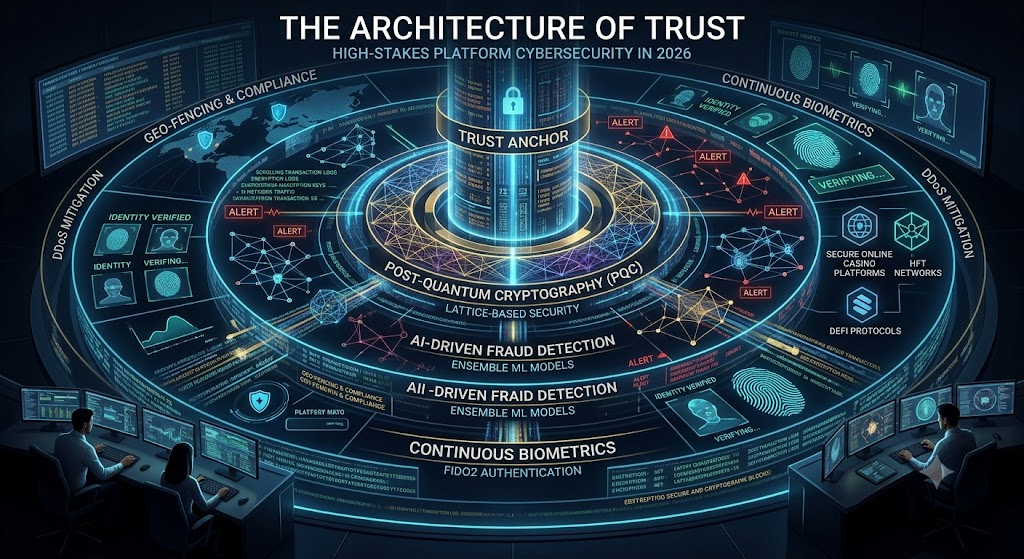
The Bloodstream of 2026: Where Nanoseconds Bleed Millions
Let’s be real for a second. The perimeter firewall is a structural joke, and anyone selling you a standard secure socket layer as a primary defense mechanism in 2026 is actively committing malpractice. We operate at the absolute apex of the digital ecosystem right now. High-frequency trading (HFT) networks and vast digital gaming grids do not measure time in seconds; they measure it in nanoseconds and micro-transactions. Look at the data. The global Quantum-AI HFT Risk market alone is tearing toward a $14.2 billion valuation by 2034 for one brutal reason: when your transaction speeds hit theoretical physical limits, your temporal window to catch a fraudster or verify a state change practically vanishes. Regulatory bodies from the SEC to the Monetary Authority of Singapore actively mandate sub-microsecond pre-trade controls to prevent systemic market collapses. Institutions dropping billions into quantum-AI fintech aren’t doing it for good public relations. A 58% reduction in intraday margin call frequency is the literal difference between market dominance and total insolvency.
Burn the Monolith: Why Legacy State Management is a Death Sentence
Move straight into the server racks, and the physical reality of the situation becomes violently clear. Monolithic software architectures and relational databases—your standard PostgreSQL or MySQL setups—are dead on arrival here. Pessimistic locking mechanisms just block execution threads when thousands of users smash the “buy” or “bet” button simultaneously. Those blocked threads cascade into API timeouts, dropped transactions, and massive revenue hemorrhage. Survival meant tearing the whole thing down to the studs. Patching a relational database under that kind of load is a fool’s errand. Engineers had no choice but to rip state management completely apart. We moved strictly to Event-Driven Architecture (EDA), bolting it directly to Command Query Responsibility Segregation (CQRS) just to keep the servers from melting. A user’s account balance isn’t a row in a database anymore. It is an immutable, mathematically verifiable sequence of state-changing events. You want to know a balance? The system replays the event log from the genesis block in microseconds. The read and write functions are physically severed to prevent bottlenecks. High-throughput Kafka clusters ingest the raw event streams, while Redis in-memory datastores serve up the materialized read-views.
The catch? Malicious actors know this system is fast, so they try to race it. A syndicate will attempt to trigger a high-volatility slot spin and an automated sports bet using the exact same account balance, praying the system processes both before the ledger updates. High-performance Player Account Management systems rely on Optimistic Concurrency Control (OCC) to kill this double-spend threat. If two microservices try to append a new event simultaneously, the version numbers clash. The database instantly rejects the write, and the application seamlessly fetches the fresh state. The ledger stays perfectly clean. More importantly, round-trip processing time never breaks that critical 50-millisecond ceiling.
The AI Arms Race and the End of the Human Analyst
The transaction verification meat grinder sits just beyond the database layer. Traditional, rule-based fraud detection engines are a complete liability today. Threat actors deploy adversarial machine learning and massive residential proxy networks to perfectly mimic human hesitation. Cybercriminals intentionally throttle their botnets; this synthetic delay mimics human typing speeds and deceives legacy classifiers. Network defenders have subsequently abandoned the rulebook entirely. We now rely on continuous, AI-driven anomaly detection pipelines. Machine learning clusters utilizing ensemble algorithms—think Random Forest and XGBoost models trained on petabytes of labeled attack vectors—crush known fraud patterns like bonus abuse syndicates or high-speed credit card testing. Catching zero-day exploits requires a totally different approach. Unsupervised models map out a rigid mathematical baseline for every single network node, screaming the second anything acts weird. Stagnant models die fast here, so security teams feed their pipelines a constant diet of fresh adversarial data just to stay afloat.
The real magic happens inside the deep learning layer. Recurrent Neural Networks (RNNs) and Long Short-Term Memory (LSTM) networks don’t just look at a single isolated data point. These systems evaluate the chronological sequence of a user’s behavior. If a supposedly legitimate user logs in from a new device and instantly bee-lines for the withdrawal page without a single intermediate click, the LSTM network nukes the session.
Geofencing, GLI-19, and the Death of the Shared Secret
This level of algorithmic paranoia is especially critical when you look at the regulatory landscape. Regulators simply do not care about your technical debt. Interactive gaming and digital wagering are arguably the most heavily scrutinized sectors on the planet, often facing stricter operational oversight than traditional commercial banking. Platforms must prove absolute micro-segmentation to survive audits under frameworks like GLI-19 v3.0 or PCI DSS v4.0. A breach in the web presentation layer must mathematically offer zero lateral access to the financial ledger. It is exactly this hostile regulatory environment that forced secure online casino platforms to become the vanguard for real-time geographic telemetry and continuous authentication. Relying on a standard IP check is essentially willful negligence today. Threat actors spin up VPNs and residential proxies for pennies. Real geographical compliance means aggressively scraping Wi-Fi triangulation, tracking GSM tower handoffs, and pulling raw gyroscopic telemetry straight from the mobile device to kill location spoofing instantly.
Frankly, the static password died years ago. Credential stuffing attacks wiped out the viability of shared secrets. Initial session authentication is now governed by the FIDO2 standard and public-key cryptography locked inside local hardware enclaves. Zero Trust dictates that a safe login means nothing five minutes later. Background scripts constantly measure the exact pressure of a screen swipe, keyboard dwell times, and mouse arcs. Steal a session token all you want. The second a human attacker or a bot moves the cursor differently than the original account owner, the system detects the biological mismatch and nukes the connection.
The Quantum Extortion Racket: Harvest Now, Decrypt Later
All of this defensive architecture rests on a mathematical foundation that is currently facing an existential threat. Cryptographically Relevant Quantum Computers (CRQCs) are no longer a sci-fi thought experiment; they are a looming, systemic crisis. Traditional public-key algorithms like RSA and ECC will be shredded by Shor’s algorithm, entirely dismantling the security of the modern digital economy. The reality is much darker than a future vulnerability. Elite syndicates and hostile nation-states operate under a “Harvest Now, Decrypt Later” strategy right this second. They are hoarding vast oceans of intercepted financial logs and interbank reconciliation data, patiently waiting for capable quantum hardware to come online. Data possessing a confidentiality lifespan extending past the next few years is already bleeding risk.
This nightmare scenario triggered the global migration to Post-Quantum Cryptography (PQC). We are tearing out decades of theoretical mathematics and shoving NIST-approved, lattice-based algorithms straight into production. Lattice-based systems derive their security from the Learning With Errors (LWE) problem. You take a massive grid of linear equations, inject mathematically calibrated noise, and suddenly the original values become computationally impossible to recover—even for a theoretical quantum processor.
The Microsecond Penalty of Sovereign Trust
The act of swapping cryptographic primitives in a system that trades in nanoseconds is a brutal engineering challenge. Hybrid cryptography—layering traditional ECC with quantum-safe algorithms in the same TLS handshake—is the only way to maintain regulatory compliance without breaking existing infrastructure.
The catch here is the latency tax. These new hybrid handshakes add roughly 0.5 milliseconds of processing time. Half a millisecond is a rounding error if you are scrolling social media. In High-Frequency Trading or live algorithmic settlement, it is a massive structural impediment. Infrastructure engineers are bolting specialized cryptographic co-processors directly onto server mainboards to offset this computational drag.
Security in 2026 is a constantly shifting, adversarial matrix. The perimeter does not exist. Every single microservice, container, and API endpoint must continuously, cryptographically prove its identity via Service Mesh architectures like SPIFFE before a single byte of data moves. We are no longer building walls around applications; we are mathematically engineering trust directly into the silicon and the data streams, aggressively outpacing the threat landscape one microsecond at a time—until the next mathematical baseline inevitably shatters.